Layer 06, Deep time
Lincoln County, Wyoming History: Settlement and Landmarks
A county created in 1911, coal towns founded in the 1890s, a valley settled in the 1870s and a lake bed that is 52 million years old. This is how the layers fit together.
Origins of the county
Lincoln County was created in 1911 from land that was previously part of Uinta County. Wyoming records give the date as 21 February 1911. Kemmerer was chosen as the county seat because it was the largest town in the new county. A decade later, in 1921, parts of the original territory were divided off to help form Sublette and Teton counties, which is why Lincoln County is smaller today than it once was.
The county is large even now. WyoHistory.org gives its area as about 4,069 square miles, the eleventh largest in Wyoming, and the 2020 Census counted 19,581 residents, up from 18,106 in 2010 and 14,573 in 2000.
Source: U.S. Census Bureau decennial census, 2000, 2010 and 2020.
Deep time before the county
The oldest layer of local history is not human at all. About 52 million years ago, according to the National Park Service, a warm freshwater lake called Fossil Lake covered this part of south-western Wyoming. Its fine sediments preserved fish, turtles, insects and plants, and the rocks that hold them are the reason Fossil Butte National Monument exists. The first scientists to study the formation arrived in the late 1860s, and the beds have been a source of fossils for museums and collectors ever since. That is why this site uses the image of rock layers: every period in the story sits on top of an older one.
Timeline at a glance
- Late 1860s: scientific study of the Green River fossil beds begins after the Union Pacific Railroad cuts through the formation near Green River.
- 1874: trapper John Welsh builds a cabin in Star Valley.
- 1878: mass settlement of Star Valley begins, and Afton is established.
- 1897: Kemmerer is founded as a coal town; Robert Craig starts quarrying fossils.
- 1899: Kemmerer is incorporated.
- 1902: J. C. Penney opens the first Golden Rule store in Kemmerer.
- 1911: Lincoln County is created, with Kemmerer as county seat.
- 1921: parts of the territory are divided off to form Sublette and Teton counties.
- 1923: a mine explosion at Frontier and Kemmerer kills 99 men.
- 1972: Fossil Butte National Monument is created.
Keep in mind that this is a short summary built from public sources such as WyoHistory.org and the National Park Service. Local museums and libraries hold far more detail, including family histories and photographs that we cannot reproduce here.
Mining and settlement
The south-east of the county was built on coal, which came out of the same basin that holds the ancient lake beds. Mining drew workers and railways, and the towns of Kemmerer, Frontier and Diamondville grew within a few miles of one another. Kemmerer was founded in 1897 by Patrick Quealy and Mahlon Kemmerer, who was the primary investor in early coal exploration, and it was incorporated in 1899. Unlike nearby Frontier and Diamondville, it was not a company-run town.
What happened in Kemmerer, Wyoming?
The most serious event in the area's history was a mine explosion on 14 August 1923 at Frontier and Kemmerer that killed 99 men. Coal mining shaped daily life in Kemmerer, Frontier and Diamondville for decades, and the loss of that day is still remembered in the area.
What is Kemmerer, Wyoming famous for?
Besides coal, Kemmerer is known as the place where James Cash Penney opened the first Golden Rule store in 1902. The J. C. Penney Historic District is a National Historic Landmark. The original frame building no longer stands, but the district and the later store that carries the Mother Store name keep the story alive. Fossils are the second pillar of the town's profile, and our Fossil Butte guide explains why. If you want to see how the towns sit today, read the towns in Lincoln County overview.
Star Valley settlement
The first known white settler in Star Valley was the trapper John Welsh, who built a cabin in 1874 with a companion and stayed only a couple of years. Mass settlement began in 1878, when members of The Church of Jesus Christ of Latter-day Saints arrived from Utah. They established Afton, and they practised polygamy until the turn of the twentieth century. If you are looking for Afton, Wyoming, Star Valley history, this is the core of it: a farming and dairy valley that grew from church-led settlement that began in the late 1870s.
Later generations turned dairying into a trademark. The valley was known as Little Switzerland for its dairies, and farming remains part of the landscape today. For the present-day side of the valley, see the Star Valley outdoor recreation guide.
Landmarks
- Fossil Butte National Monument (1972). Created on 23 October 1972 to protect fossils from Fossil Lake. Scientific interest in the Green River fossil beds began in the late 1860s, after the Union Pacific Railroad cut through the formation near Green River, and commercial quarrying near Kemmerer began with Robert Craig in 1897. A commercial quarry on state land has operated near the monument since 1943.
- J. C. Penney Historic District, Kemmerer. A National Historic Landmark district connected to the first Golden Rule store.
- Afton's elk antler arch. A large arch of shed elk antlers that crosses US Highway 89 in the centre of Afton and has become a symbol of Star Valley.
- Protected public land. Part of the Bridger-Teton and Caribou-Targhee national forests and Cokeville Meadows National Wildlife Refuge lie in the county.
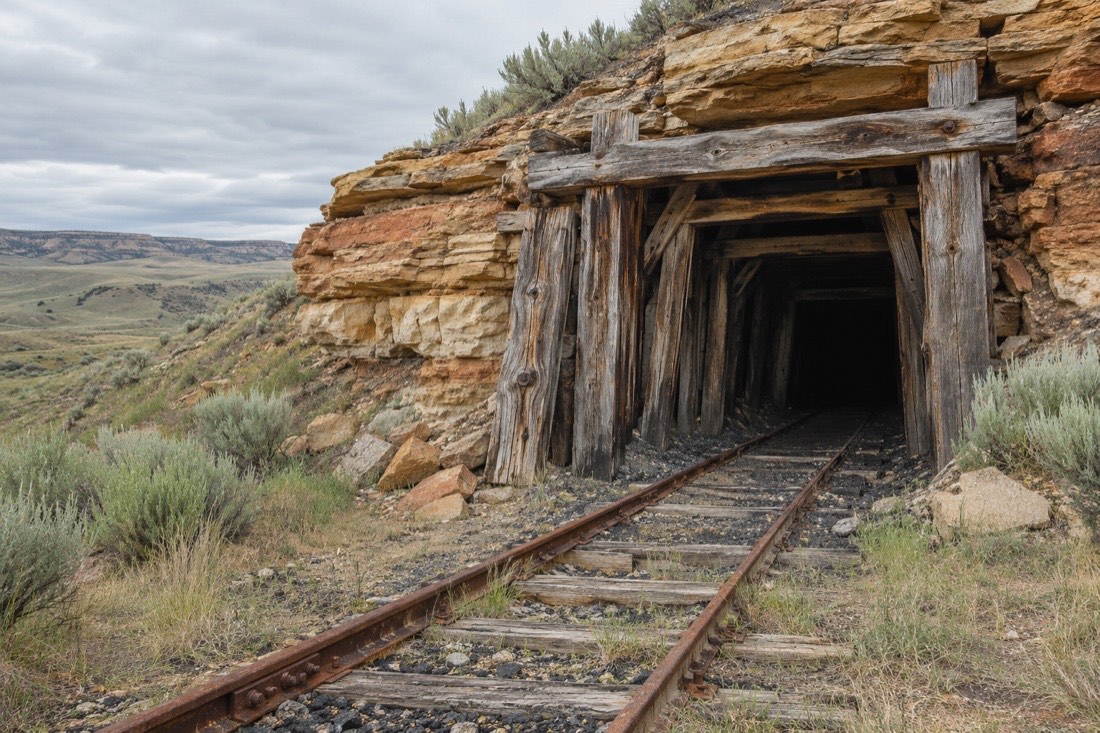
History here is also physical. Old mine workings, railway grades, farm fences and early town grids are still part of the working landscape, and many are on private land. Treat them as you would any other property: look from the road, ask permission, and leave things as you find them. Local libraries and museums are the best places to go deeper.
Looking for a Lincoln County, Wyoming history map? The county's landmarks are scattered, so it is easiest to plan your route with current road maps and the things to do overview. For a broader introduction start on the home page.